
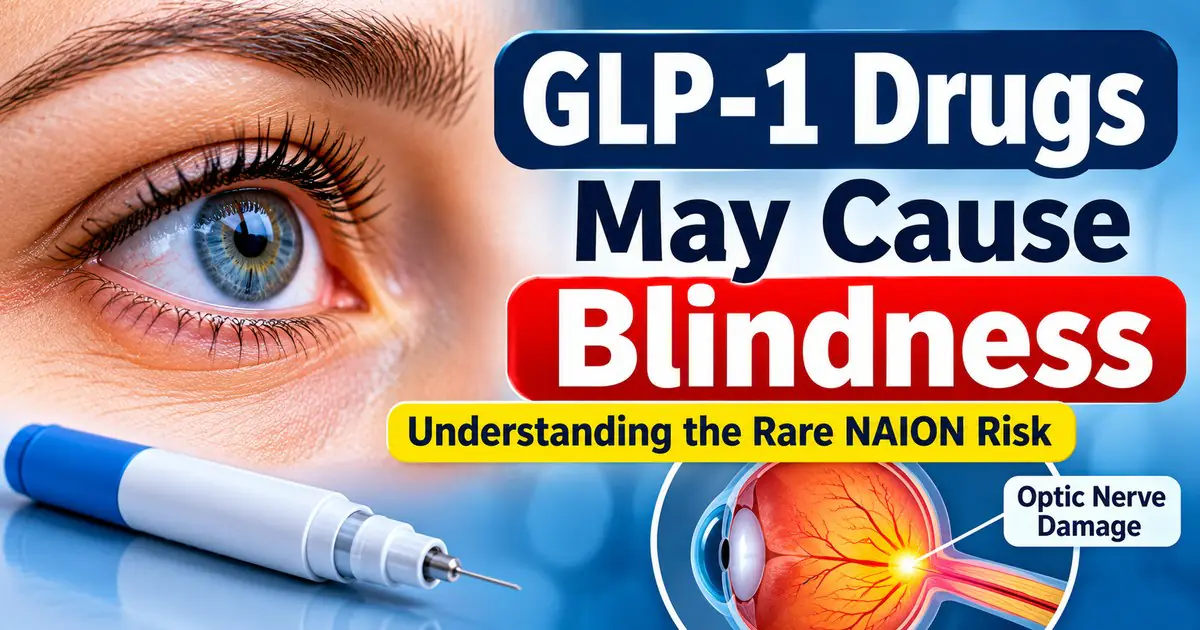
GLP-1 medicines may be linked to rare, serious vision loss, but evidence does not prove they cause blindness. The absolute risk appears low. By March 2026, less than 6% of U.S. adults had taken GLP-1 agonists for type 2 diabetes or weight loss. NAION is the main serious eye concern under study, but an association does not prove these medicines cause it.
Ozempic, Wegovy, Rybelsus, Trulicity, Mounjaro, and Saxenda are common examples. Semaglutide and tirzepatide are also under study. A change in vision does not always mean lasting eye damage. This overview explains what the concern means, which changes need urgent care, and how to discuss your own risks.

Key Takeaways
- NAION is a relatively uncommon cause of vision changes, not a diagnosis for everyone with vision changes.
- Studies show different results across treatment comparisons.
- Diabetes can affect the retina and cause temporary lens-related blur.
- Sudden vision loss needs emergency assessment.
- Talk about treatment choices with your prescriber and eye doctor.
The headline phrase describes a concern, not a diagnosis that applies to everyone taking these medicines.
What is NAION and Will It Damage Your Vision
NAION is an optic nerve injury that often occurs without pain, but it can reduce or fade vision. NAION is optic nerve damage from a reduced blood supply. This can lead to loss of vision in some areas or complete loss of field of vision in one eye.
The change often starts when you wake up or notice a new dim area. NAION is short for non-arteritic anterior ischemic optic neuropathy. Eye stroke is an informal term, not to be confused with a brain stroke.
NAION is rare, with an annual incidence of 2.3 to 10.2 cases per 100,000 people. Vision loss is often permanent. About one-third of patients may have mild spontaneous improvement, and up to one-quarter may later develop NAION in the other eye.
Diabetes can affect blood flow and eye health, but NAION is not the only cause of vision changes. Its sudden onset matters, even when the change seems small. The possibility of some spontaneous improvement does not make sudden vision loss safe to watch at home.
GLP-1 Drugs May Cause Blindness: What the Evidence Shows
The FDA’s evidence points to a possible rare risk, but the size of the signal changes with the comparison group and study design. The studies do not give you one personal probability of NAION.
Across research on ischemic optic neuropathy, results depend on who receives each treatment and how researchers count events. The FDA concluded that GLP-1-receptor agonists may increase the risk of rare NAION. It is adding NAION information to the Warnings and Precautions section of all GLP-1 RA labels.

Clinical trials and treatment comparisons
An FDA meta-analysis of 126 trials included 134,253 patients. It found 6.4 NAION events per 100,000 patient-years among GLP-1 RA users, compared with 3.8 among comparator-treated patients. Patient-years account for both the number of people and their time in a study.
A separate FDA study examined adults with type 2 diabetes who began treatment from 2019 through 2024. Rates were close across three medication groups:
| Evidence group | Comparison | Result | What the result means |
|---|---|---|---|
| Clinical-trial meta-analysis | GLP-1 RAs vs. comparators | 6.4 vs. 3.8 per 100,000 patient-years | More events appeared among GLP-1 RA users |
| FDA retrospective study | GLP-1 RAs, SGLT-2 inhibitors, DPP-4 inhibitors | 30-32, 31 and 26 per 100,000 patient-years | Rates were similar across groups |
| Sentinel, SGLT-2 comparison | GLP-1 RAs vs. SGLT-2 inhibitors | Hazard ratio 1.19; 95% CI 0.91-1.54 | No statistically significant increase |
| Sentinel, DPP-4 comparison | GLP-1 RAs vs. DPP-4 inhibitors | Hazard ratio 1.43; 95% CI 1.02-2.01 | An increased risk signal appeared |
The trial and retrospective-study rates use patient-years. They are not the annual incidence among all people, which is lower. A hazard ratio is a comparison between the event rates at any time point between groups. The FDA’s NAION safety review reports these findings.
Adverse-event reports signal concern, not certainty
The FDA found NAION reports for all currently marketed GLP-1 RA products. From December 2017 through December 2024, reports named Wegovy 28 times and Ozempic 47 times. These are reports, not incidence rates.
Report analyses showed odds signals nearly 75 for Wegovy and nearly 19 for Ozempic. The signal for Wegovy was almost five times higher than for Ozempic, and it was more than three times higher in men than in women. Spontaneous reports can be incomplete and cannot show how often an event occurs among all users.
A GLP-1 blindness percentage cannot be calculated from spontaneous reports or a relative-risk signal alone. Such signals can guide further study, but they do not show that a medicine caused a particular person’s condition. Treat a report count or odds signal as a reason for continued evaluation, not as your personal chance of blindness.
Which Other Eye Changes May Matter?
A vision change on a GLP-1 medicine can reflect diabetic eye disease or a temporary lens change, not only NAION. Both type 1 and type 2 diabetes can cause diabetic retinopathy, often through blood-sugar-related damage to retinal blood vessels.
Diabetic retinopathy can threaten vision as it worsens. Diabetic macular edema is swelling in the retina’s central area. It can occur with diabetic retinopathy and affect clear central vision.
Diabetic retinopathy and Zepbound labeling
The FDA-approved Zepbound prescribing information, revised in February 2026, says tirzepatide has not been studied in people with these conditions:
- Nonproliferative diabetic retinopathy requiring acute therapy
- Proliferative diabetic retinopathy
- Diabetic macular edema
The label advises monitoring people with a history of diabetic retinopathy for progression. That advice matters if you have diabetes and use Zepbound or are considering it.
Temporary blur and other retinal conditions
| Eye issue | What it affects | What is known in this context | Practical implication |
|---|---|---|---|
| Diabetic retinopathy | Retinal blood vessels | Both types of diabetes can cause it | Track changes with an eye doctor |
| Diabetic macular edema | Central retina | Not studied in some Zepbound patients | Follow label monitoring advice |
| Temporary lens-related blur | Eye lens and focus | Blood-sugar shifts can change lens shape | New or worsening blur needs assessment |
| Age-related macular degeneration | Central retina | GLP-1 findings are mixed | Not a confirmed GLP-1 side effect |
Blood sugar changes can alter the eye’s lens shape and blur your vision. Wegovy-related blur from blood-sugar changes may settle after three or four months, but new or worsening symptoms still need clinical assessment. Findings about macular degeneration are mixed and do not establish it as a confirmed GLP-1 side effect.
A history of diabetic retinopathy is a reason to follow the Zepbound label’s monitoring advice, not to assume treatment is automatically unsuitable.
Which Vision Changes Need Emergency Care?
Sudden loss, dimming, or a missing area of vision is an emergency, even when it does not hurt. Go to an emergency room right away for sudden loss in one eye, both eyes, or any part of your visual field.
NAION is a leading cause of sudden, painless vision loss in one eye, but symptoms alone cannot identify the cause. Watch for these changes:
- Sudden painless loss or dimming in one eye
- A dark or missing patch in central or side vision
- Sudden blurry or hazy vision
- Faded colors or a new shadow

Sudden loss, dimming, or a missing area
Vision loss can develop over seconds, minutes, or a few days. A missing patch may affect your central view or the side of your vision. Even a painless change can signal damage to the optic nerve, retina or blood vessels.
Other urgent causes of sudden vision loss
Retinal detachment, retinal artery or vein blockage, stroke, acute glaucoma and optic neuritis can also cause sudden vision loss. Each can threaten sight and needs prompt medical care. The most common cause of sudden blindness in one eye cannot be identified from symptoms alone; NAION is a leading cause of sudden, painless loss.
Do not wait for a routine appointment or assume a medication caused the change. Emergency staff can assess sudden loss in one eye, both eyes, or part of your visual field. Do not wait to see whether sudden vision loss clears on its own.
Who May Need Closer Eye Monitoring?
Your diabetes history, blood pressure, sleep apnea, and optic nerve anatomy can all shape the eye-monitoring plan. These health factors can affect NAION risk apart from any GLP-1 medicine.
Common risk factors include age over 50, diabetes, high blood pressure, obstructive sleep apnea and a naturally crowded optic disc. A crowded disc leaves less room for the optic nerve’s blood vessels and fibers. If you have these conditions and you are taking medication, tell your eye doctor.

Health and anatomy risk factors
People with diabetes may need closer teamwork between their diabetes and eye care. A rapid fall in blood sugar can affect existing diabetic eye disease. Closer coordination during the first 12 to 18 months may help when blood sugar could fall quickly, especially if you already have eye disease.
Build eye checks into diabetes care
Use these points to prepare for an eye visit:
- Tell your ophthalmologist every medication you take.
- Keep regular eye exams.
- Mention past diabetic retinopathy or other eye disease.
- Ask your care team what follow-up fits your health history.
Regular examinations help your eye doctor monitor vision changes and diabetic retinopathy. Your treatment plan may involve more than one clinician, particularly when diabetes affects your retina or blood vessels. Bring your current medication list to your next eye examination.
Should You Stop a GLP-1 Medicine if Your Vision Changes?
A vision concern is a reason to contact your care team, not to stop a GLP-1 medicine without medical advice. Never reduce or cease a medication without your doctor’s authorization. An eye symptom needs assessment, not an automatic assumption that the medicine caused it.
The American Academy of Ophthalmology and the North American Neuro-Ophthalmology Society describe the possible increase in NAION risk as low. They recommend shared decision-making about starting, continuing, or stopping treatment.
Your choice depends on your diagnosis, eye history, diabetes or weight-loss goals, other health risks, and treatment options. Your prescriber and ophthalmologist can weigh these points with you. A NAION diagnosis may change that discussion, but it does not create the same answer for every person.
Talk to your prescriber and eye doctor together about who makes the treatment decision.
If you are comparing treatment options, read our guide to Wegovy vs. Zepbound. Discuss the benefits and risks of each medicine with your prescribing clinician.
What Does the NAION Lawsuit Count Mean?
A lawsuit count measures active legal cases, not the number of people medically proven to have drug-caused NAION. There were 278 active federal GLP-1 NAION cases in November 2026.
A case is a legal claim, not a medical finding that a medicine caused the condition. The count also cannot predict your health outcome or show how often NAION occurs among people taking these medications.
These legal proceedings do not establish that GLP-1 medicines cause NAION. A lawsuit contains allegations that must be evaluated through the legal process. Medical decisions should instead be based on a patient’s symptoms, clinical history, current evidence, and advice from qualified healthcare professionals.
Conclusion
The key takeaway is to take sudden vision changes seriously without assuming the medicine is their proven cause. Current evidence supports awareness and shared decision-making, not the belief that every GLP-1 medicine causes blindness.
NAION remains a rare concern, while retinal disease and blood-sugar shifts can cause other vision changes. Your diabetes history, eye health, and weight goals all matter when you weigh treatment.
Arrange a conversation with your prescriber and eye doctor about your medication, diabetes history, and eye-exam plan before changing treatment. Ask your prescriber and eye doctor to review your personal eye risks before you start, continue, or change treatment.
FAQ
Can Ozempic cause permanent damage?
Ozempic has a possible association with NAION, but research has not proved it causes the condition. NAION can injure the optic nerve and cause vision loss that is often permanent. An eye change while taking Ozempic does not, by itself, show the medicine caused damage. A clinician needs to assess the symptom and your eye health.
Can vision loss from GLP-1 be reversed?
Vision loss from NAION is often permanent, though about one-third of patients may have mild spontaneous improvement. The amount of change and the reason for changing is important. Sudden vision loss needs immediate emergency assessment, rather than waiting to see whether sight returns. Other eye conditions may have different outcomes and need different care.
Why am I suddenly having vision problems?
Sudden vision problems can come from NAION, retinal detachment, retinal vessel blockage, stroke, acute glaucoma, or optic neuritis. Symptoms alone cannot tell you which condition is responsible. Sudden loss in one eye, both eyes, or part of your visual field needs immediate emergency room evaluation. Do not wait for a routine visit.
What drug messes up your vision?
No single drug can be named as the cause from a vision symptom alone. GLP-1 medicines have a possible association with NAION, but that does not prove causation. Blood-sugar changes during treatment can also alter the eye’s lens and cause temporary blur. Share any new vision changes and your full medication list with a clinician.
What is the quickest way to fix blurry vision?
There is no safe fix that works for every cause of blurry vision. Sudden or severe changes need emergency assessment, since several eye and health conditions can cause them. Blood-sugar-related blur may settle as levels stabilize, often after three or four months. New or worsening blur still needs clinical assessment.
What eye issues can Zepbound cause?
Zepbound’s label advises monitoring people with a history of diabetic retinopathy for progression. It also says tirzepatide has not been studied in patients with nonproliferative diabetic retinopathy needing acute therapy, proliferative diabetic retinopathy, or diabetic macular edema. These label notes do not mean every person taking Zepbound will develop an eye problem.