
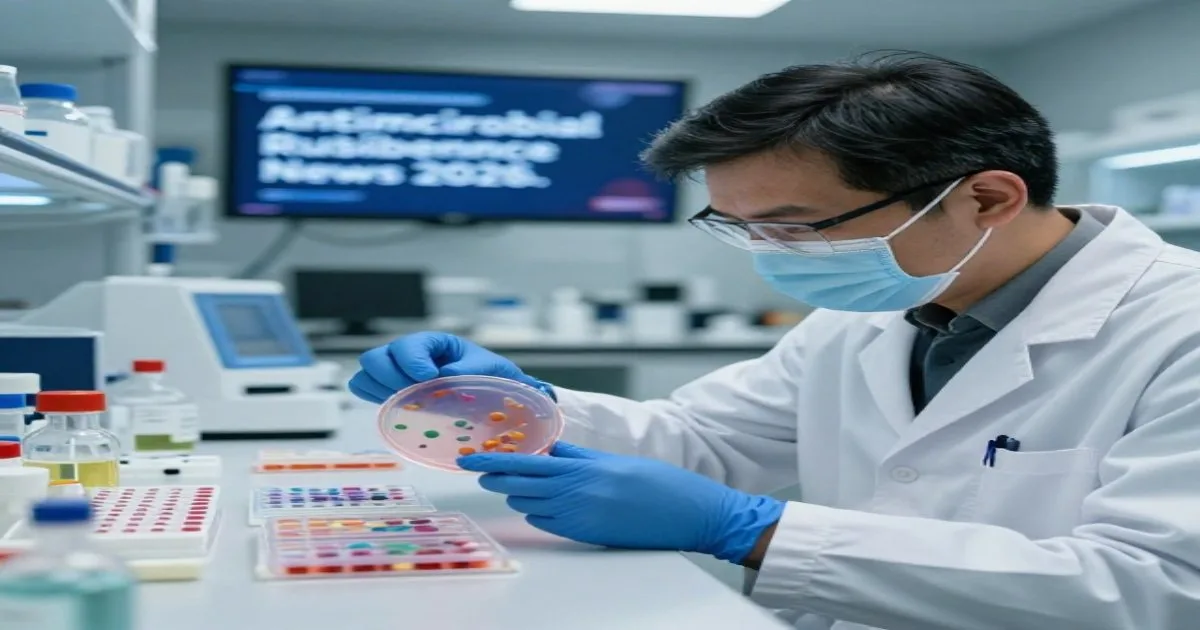
In 2026, antimicrobial resistance is a present-day health challenge in the United States, not a distant warning. Antimicrobial Resistance News 2026 centers on the growing risk of drug-resistant infections and the uneven response. Antimicrobial resistance (AMR) is when bacteria, viruses, fungi, and parasites are able to resist, survive, or grow as drugs are being employed to eradicate them.
For you, the issue reaches beyond rare infections. Resistance can make routine patient care harder when an infection does not respond to the medicine chosen to treat it. U.S. public health teams track that burden while researchers, clinicians, and policymakers work to slow it. Their progress is real, but it does not move at the same pace everywhere.
This overview separates current health effects from research, policy, and prevention. It also explains what new data can and cannot tell you about risk. For a clear picture, keep the scale of the problem separate from the progress of the response.

Key Takeaways
- AMR includes resistance involving bacteria, viruses, fungi, and parasites.
- In 2023, more than 16% of all tested bacterial infections resisted antibiotic treatment worldwide.
- US estimates based on 2023 data show a major annual burden.
- Pathogen trends differ: some rose while others fell.
- New treatments, testing, prevention, and responsible medicine use all matter.
- Ask a clinician about test results and treatment changes.
Antimicrobial Resistance News 2026: The Global Picture
Approximately one in six bacterial infections worldwide that were confirmed through laboratories was antibiotic-resistant in 2023. That figure describes tested bacterial infections, not every infection worldwide. It shows why antibiotic resistance already affects care, even as longer-term projections point to a larger threat.
Non-susceptibility to drugs of a wide range of viruses, bacteria, fungi and parasites is AMR. Antibiotic resistance covers only bacteria and antibiotics, so it is one part of the wider problem. The World Health Organization tracks resistance as a world health concern because effective treatment can become harder to find.
When antibiotics fail, an infection may need different treatment or more time to clear. That can complicate care around routine surgery and childbirth, where preventing or treating infections matters. Bacterial infections that once responded to standard medicines can also require more complex care.
Long-term projections are different from the 2023 infection measure. Drug-resistant infections could kill 39 million people in the next 25 years. This is a projection across years, not a count of deaths already recorded in 2023.
The economic estimates also look ahead. Resistant bacterial infections could cost US$412 billion each year through 2035. Lost work and other productivity effects could add US$443 billion per year. Those estimates show how resistance can affect people and health systems beyond direct medical bills.
These numbers do not mean every resistant infection will be untreatable. They show that resistance can limit the medicines that work and raise the stakes of prevention and research. The core issue is not only whether a medicine exists, but whether it can still treat the infection in front of you.
The U.S. burden reaches hospitals and communities
The latest US estimates put the annual burden at 9.7 million infections and 50,800 deaths. Both estimates are based on data collected in 2023. They cover drug-resistant bacteria and fungi across the country, not just infections linked to hospitals.
That broad count includes people who receive care in hospitals and people whose infections begin in the community. Drug-resistant pathogens cause an estimated 50,800 US deaths each year. These totals help show the scale of the health burden, but they do not describe one patient’s risk.
Infections that commonly occur in hospital patients account for a separate, narrower measure. This caused more than 42,000 deaths in the US and over $12 billion in healthcare costs in 2023. Hospital-associated infections form part of the wider burden, so the two measures should not be added together.
Those hospital costs include pressure on care teams and health services. Infections that are resistant can take longer or be more difficult to treat, and patients may need more careful supervision. The national totals bring together many pathogens and settings, which is why they do not explain every local trend.
CDC cautions that readers should not directly compare these estimates with its 2019 report. The data sources and methods changed substantially between the reports. A change in how cases are counted can affect a total, even when the underlying health picture has not changed by the same amount.
These 2023 estimates give you a current view of the burden, with limits that matter when reading older figures. Read the current totals as a new measurement, not as a simple year-over-year comparison with 2019.
Which U.S. pathogens show the clearest changes?
The US pathogen picture is mixed: Candida auris and CRE rose sharply, while C. difficile infections fell. One falling infection trend does not mean every resistant pathogen is declining. Each organism has its own pattern, time frame, and count.
The table separates measured changes from the number reported in 2023 or the latest period listed. CRE means carbapenem-resistant Enterobacterales, a group of bacteria. Its count includes cases that began in the community.
| Pathogen | Measured change | Period | 2023 or latest reported count |
|---|---|---|---|
| Candida auris | 10-fold increase | 2019-2023 | 4,523 US infections in 2023 |
| CRE | 18% increase | 2019-2023 | 14,878 US cases in 2023 |
| C. difficile | 9% decline | 2018-2023 | Not stated |
| Ciprofloxacin-resistant Neisseria meningitidis | More than doubled | 2019-2023 | Estimated cases; count not stated |
| Penicillin-resistant Neisseria meningitidis | Tripled | 2019-2023 | Estimated cases; count not stated |
The Candida auris increase matters because the reported fatality rate ranges from 29% to 62%. That range does not mean every person with the infection will die. It describes a reported rate across cases and settings.
CRE cases also show why location of onset matters: 67% of the 14,878 cases began in the community. For Neisseria meningitidis, the figures are estimated case counts, not a full count of confirmed infections. These changes involve different organisms and measures, so a single national trend line would hide important differences.
The 9% decline in C. difficile infections is a positive change for that infection. It does not cancel increases in Candida auris, CRE, or resistant meningococcal cases. Treat the trend for each organism as its own signal rather than assuming one national curve fits all pathogens.
How CDC classifies urgent threats and its Watch List
CDC separates its urgent-threat category from a Watch List of organisms that need continued attention. The two labels are not the same risk category. Urgent threats name pathogens that pose a major concern, while Watch List status signals a need to track changes and prepare.
CDC lists four organisms as urgent threats:
- Candida auris
- Carbapenem-resistant Acinetobacter
- Carbapenem-resistant Enterobacterales
- Drug-resistant Neisseria gonorrhoeae
The Watch List includes azole-resistant Aspergillus fumigatus, drug-resistant Bordetella pertussis, drug-resistant dermatophytes, drug-resistant Haemophilus influenzae, drug-resistant Mycoplasma genitalium, and nontuberculous mycobacteria. A Watch List designation calls for attention, but it does not classify an organism as an urgent threat.
That distinction matters because the labels help public health teams organize attention. They do not tell you whether a particular infection is present or which treatment will work. Clinicians need to assess the infection and relevant test results for each patient.
Macrolide-resistant Bordetella pertussis is a notable return within this wider tracking system. Two US cases were identified in 2024 and 2025. They were the first reported cases of this type since 2018, making them a specific signal rather than a broad claim about every pertussis infection.
These categories help CDC flag threats and organisms that merit continued study. They do not replace diagnosis or treatment decisions for an individual. The two macrolide-resistant pertussis cases identified in 2024 and 2025 are the first reported since 2018.
What WHO’s 2024 pathogen priorities rank highest
Carbapenem-resistant Klebsiella pneumoniae ranked highest on WHO’s 2024 list, with a score of 84%. The score ranks a public health priority; it is not an infection rate. WHO’s list helps guide attention to antibiotic-resistant bacteria and antibiotic development.
How WHO assessed the bacterial priorities
The World Health Organization evaluated 24 antibiotic-resistant bacterial pathogens using eight criteria. The criteria cover mortality, non-fatal burden, incidence, resistance trends over 10 years, preventability, transmissibility, treatability, and the antibacterial pipeline.
This approach looks beyond the number of cases. A pathogen may rank highly because it causes severe illness, spreads easily, resists treatment, or has few products in development. The assessment combines these factors into a priority score to help guide research and public health work.
Pathogens at the top and bottom of the list
These five scores show the range across the listed bacterial priorities:
| Pathogen | Resistance type | Score |
|---|---|---|
| Klebsiella pneumoniae | Carbapenem-resistant | 84% |
| Salmonella Typhi | Fluoroquinolone-resistant | 72% |
| Shigella spp. | Antibiotic-resistant | 70% |
| Neisseria gonorrhoeae | Antibiotic-resistant | 64% |
| Group B streptococci | Penicillin-resistant | 28% |
WHO reclassified Pseudomonas aeruginosa from critical to high priority. It also added macrolide-resistant group A streptococci and penicillin-resistant group B streptococci. Penicillin-resistant group B streptococci scored 28%, the lowest score on the 2024 list.
Priority scores help compare public health concerns, not predict what will happen to one person. A priority score guides attention and research; it is not a patient’s probability of infection or death.
Where resistance is rising across regions and diseases
Resistance rose in more than 40% of monitored pathogen-antibiotic combinations between 2018 and 2023. Average annual increases in those combinations ranged from 5% to 15%. The pattern varies by disease and region, so a global average cannot describe every place.
The findings below cover different populations and types of surveillance. A reported rate describes infections that were tested or reported, not every infection in a region. Testing access and reporting practices affect what surveillance data can show.
| Measure | Population or region | Finding |
|---|---|---|
| Resistance trend | Monitored pathogen-antibiotic combinations | More than 40% rose, 2018-2023; 5%-15% average annual rise |
| Reported resistant infections | WHO South-East Asia and Eastern Mediterranean regions | About 1 in 3 reported infections |
| Gonorrhoea resistance | Global; some regions | Ciprofloxacin resistance estimated at 75%; ceftriaxone resistance rising in some regions |
| Drug-resistant TB | People with TB in 2024 | 3.2% of first episodes; 16% of previously treated cases |

The two WHO regions with about one in three reported infections resistant face a substantial burden among infections recorded through surveillance. That measure does not mean one in three people in those regions has a resistant infection. It applies to reported infections in the stated regions.
Gonorrhoea shows a separate concern. Global ciprofloxacin resistance is estimated at 75%, while ceftriaxone resistance is rising in some regions. Drug-resistant TB also affects different groups at different rates: the estimate is 3.2% for people with a first TB episode and 16% for people treated before.
Testing and reporting shape every one of these estimates. A rate is most useful when you know which infection, population, and testing system it describes.
Antibiotic use targets put access drugs in focus
Access antibiotics made up 53% of global human antibiotic use in 2022, below the 70% target for 2030. The target calls for at least 70% of antibiotic use to come from the access group. It is a population-level goal, not an instruction for your own prescription.
WHO’s AWaRe groups sort antibiotics into Access, Watch, and Reserve categories. Access antibiotics are recommended first-choice treatments for many common infections. Watch antibiotics need more careful use because of resistance concerns.
| Category | Share of global human antibiotic use in 2022 | Target context |
|---|---|---|
| Access | 53% | At least 70% by 2030 |
| Watch | Roughly 45% | Use more carefully due to resistance concerns |
| 2030 access target | Not a 2022 share | At least 70% of antibiotic use |
The table describes global human antibiotic use in 2022 and the later target. The access share and watch share are approximate parts of that reported mix. They show how the AWaRe groups help health systems review patterns in antibiotic use over time.
Access does not mean a medicine is right for every infection. Watch does not mean a medicine is always wrong. The right antibiotic depends on the infection, test results, and clinical judgment, not on a global share alone.
These categories support stewardship, the careful use of medicines to protect their value. They are a framework for health systems and clinicians to review use. Never switch or stop a prescribed antibiotic to match a population-level target.
Diagnostics and prevention can reduce avoidable treatment
A clinician can choose a more appropriate treatment when reliable testing identifies the cause of an infection. Testing only helps when the right test and lab capacity are accessible at the point of care. A result that arrives too late or cannot guide treatment offers less help.
What diagnostic capacity should include
WHO diagnostic tools describe tests that should be available at each level of healthcare, from primary-care centers to referral hospitals. A separate tool brings together 73 laboratory procedures, from collecting a sample to identifying a pathogen and testing medicine response.
Susceptibility testing checks which medicines can stop or kill the infection-causing organism. It can help a clinician see whether an antibiotic is likely to work. The LabMedica report on WHO diagnostic tools describes the tests and procedures covered by these tools.
Prevention measures that lower infection risk
Testing can guide care, while prevention can stop some infections before treatment is needed. Four measures support that work:
- Infection prevention and control
- Vaccination
- Clean water and sanitation
- Appropriate antimicrobial use
Infection prevention protects patients and care teams, while vaccination lowers the risk of some illnesses. Clean water and sanitation help reduce the spread of infections. Appropriate medicine use helps preserve treatments when they are needed.
For you, access to a test matters as much as the test itself. A diagnostic pathway is only useful when a patient can reach the test and the result can guide care.
The antibiotic pipeline faces a thinner industry base
The 2026 pipeline picture is mixed: large-company projects have contracted, while some innovative approvals and late-stage candidates remain. Large research-based pharmaceutical companies’ pipeline projects shrank by 35% over the previous five years. A smaller pipeline can leave fewer candidates moving toward future treatment options.
What the 2026 Benchmark reports
The Benchmark also reports that three large companies continued investing in innovative antimicrobial research and development. It identifies recent regulatory approvals for three antibiotics with innovative characteristics. Several promising products also remain in late-stage development.
These findings point in different directions. Continued investment and late-stage products offer signs of progress, but they do not erase the decline in large-company pipeline projects. The 2026 Antimicrobial Resistance Benchmark describes both the contraction and the products still moving forward.
Why discovery and development need support
Antibiotic discovery is hard to sustain because new medicines must be used carefully to slow resistance. That careful use can limit sales, even when a new medicine meets an urgent need. Companies and research teams face a different market from one built on medicines used often.
Research progress does not equal a treatment that a clinician can prescribe. A candidate must pass development steps and receive regulatory approval before it becomes an approved option. Late-stage products may still fail or change before that point.
That distinction helps you read pipeline reports without mistaking hope for access. A promising candidate is not a treatment option until it completes development and receives regulatory approval.
Recent antibiotic approvals add options for specific infections
The most useful way to read a new antibiotic approval is by its exact infection indication and patient group. FDA approvals apply to specified uses, not every infection caused by a resistant organism. The recent approvals cover distinct urinary tract infections and uncomplicated urogenital gonorrhoea.
New options for urinary tract infections
The FDA approved gepotidacin in December 2025 for uncomplicated urinary tract infections. That indication is different from complicated urinary tract infections, which can involve greater treatment needs or fewer oral options.
On June 17, 2026, FDA approved Utebzi, or tebipenem pivoxil, as an oral antibiotic for complicated urinary tract infections in adults. Its approval covers adults with limited or no alternative oral treatment options. That patient condition is part of the approved use.
A clinician must assess the infection, susceptibility, and patient-specific factors before choosing treatment. A medicine approved for uncomplicated infection does not automatically suit a complicated one. The urinary tract infection type and available alternatives both matter.
A new option for uncomplicated gonorrhoea
FDA approved zoliflodacin in December 2025 for uncomplicated urogenital gonorrhoea. That approval names a specific infection and does not make it a choice for other infections or every patient.
Antibiotic treatment depends on the clinical picture, including test results and a person’s health needs. An approval adds an option for the specified use, not a reason to take an antibiotic without clinical direction.
Funding programs and incentives aim to support development
US antimicrobial research support ranges from targeted project calls to proposed payments for qualifying medicines. The CARB-X application window for its second 2026 round closes November 23, 2026. Other programs support research, diagnostics, and stewardship through different routes.
Grants and contracts for research teams
Researchers and developers can look at four types of support:
- CARB-X’s second 2026 round accepts applications November 10-23. Themes include Gram-negative infection therapeutics, target-based novel chemistry, non-vaccine neonatal sepsis prevention, and neonatal sepsis diagnostics.
- BARDA announcement BAA-23-100-SOL-00004 supports antibacterial and antifungal agents and antibiotic-resistance diagnostics for priority bacterial pathogens. Its application period ends September 25, 2028.
- CDC maintains a rolling dashboard of antimicrobial-resistance research funding opportunities.
- PASTEUR includes proposed pilot funding for outpatient antibiotic stewardship.
Each route serves a different need, from early research to diagnostics or responsible outpatient use. The CARB-X themes include both treatment work and ways to prevent or diagnose neonatal sepsis.
Subscription incentives for new medicines
The updated PASTEUR Act proposes subscription-style contracts of $75 million-$300 million per year for qualifying antibiotics and antifungals. A subscription would pay for access rather than relying only on sales volume, which may help address the market barriers around careful use.
Eligibility and contract size would depend on scores for innovation, patient outcomes, and public health benefit. The proposal is an updated bill, not an enacted payment program. Researchers and developers should check each program’s current eligibility and submission status before preparing an application.
Funding calls and proposed incentives have different rules and timelines. Check each program’s current eligibility and submission status before preparing an application.
FDA actions address antimicrobial use in food animals
FDA’s 2026 guidance asks sponsors to voluntarily define how long certain medically important animal drugs should be used. GFI #273 applies to certain approved drugs for food animals that lack a defined duration. The guidance recommends that sponsors set those durations voluntarily.
The recommendation is not a new mandatory rule for every animal drug. It focuses on medically important antimicrobials with no defined duration of use. Defining a duration can clarify how long a drug is intended to be given.

FDA finalized GFI #273 on February 12, 2026. That date anchors the guidance, while its voluntary scope defines what sponsors are being asked to do. The guidance concerns certain approved products, not all antimicrobial use in food animals.
FDA sales and distribution data offer another measure. Sales of medically important antimicrobials for food animals fell 2% from 2022 to 2023. They were 37% below the 2015 peak. These figures track sales and distribution, not the full amount used on farms.
Monitoring also includes the National Antimicrobial Resistance Monitoring System, or NARMS. The comment period for its 2026-2030 Strategic Plan ran January 10-March 26, 2025. That process belongs to monitoring plans, separate from the finalized guidance on drug-use duration.
Sales data can help track one part of the issue, but do not measure resistance across every setting. A fall in sales is a specific measure of distribution, not a complete measure of resistance across people, animals, and the environment.
National plans need implementation and One Health coordination
Having a national plan is not the same as funding it, carrying it out, and tracking results. Nearly 9 in 10 of 183 countries had a national AMR action plan, but only 42 had one financed, implemented, and monitored. That gap shows why a written plan alone cannot ensure action.
More countries have plans than fully operational programs
A national action plan, or NAP, sets out a country’s intended response. To become operational, it needs financing, implementation, and monitoring. Those steps can show whether planned work reaches health services and whether results call for changes.
The difference between having a plan and carrying it out matters for global health. A review of global AMR plans describes uneven implementation and coordination across human, animal, and environmental systems.
The 2026-2036 global plan sets shared priorities
The World Health Organization’s Global Action Plan on AMR covers 2026-2036. Its six strategic objectives call for:
- Awareness and behavior change
- Surveillance and laboratory networks
- Infection prevention
- Equitable access and appropriate use
- Research and innovation
- Multisector governance, financing, and accountability
The One Health partners are WHO, the Food and Agriculture Organization (FAO), the United Nations Environment Programme (UNEP), and the World Organisation for Animal Health (WOAH). Their work links human health with animals and the environment.
The plan aims to support a 10% reduction in bacterial AMR-associated human deaths by 2030. That is a goal, not a guarantee that deaths will fall by that amount. A plan’s practical value depends on sustained financing, coordinated sectors, and evidence that informs adjustments.
Resistance also affects fungi, viruses, and parasites
Antibiotic resistance is only one part of AMR, which also affects antifungal, antiviral, and antiparasitic treatment. Resistance can narrow treatment choices for infections caused by fungi, viruses, and parasites too. Each type involves different organisms and medicines.
Azole-resistant Aspergillus is one fungal example. Azoles are a group of antifungal medicines. Multidrug-resistant Candida auris is another, showing that fungal resistance can involve several medicines rather than one drug class.
Health teams also monitor antiviral resistance in HIV and influenza. Resistance in these viruses can make some antiviral medicines less effective. It is not the same process or treatment challenge as antibiotic resistance in bacteria.
Drug-resistant parasites can affect malaria treatment with artemisinin-based combination therapies. Resistance may also threaten neglected tropical disease programs for leishmaniasis and human African trypanosomiasis. These illnesses involve parasites and antiparasitic medicines, not bacterial infections and antibiotics.
That wider scope matters when you hear AMR used as a general term. A response focused only on new antibiotics would miss fungal, viral, and parasitic threats. The right response depends on the organism and medicine involved, not on assuming every resistant infection behaves like a bacterial one.
What you can do to reduce avoidable risk
Your most useful step is to take an antibiotic only when a qualified clinician prescribes it for you. Antibiotics treat bacterial infections, not viral illnesses such as influenza or COVID-19. A clinician may identify a bacterial infection that needs treatment, but antibiotics do not treat the viruses themselves.
Everyday choices can help lower infection risk and reduce avoidable antibiotic use. These five steps support appropriate care:
- Take antibiotics only as prescribed for you.
- Do not share antibiotics or save leftovers for another illness.
- Ask whether testing can guide treatment when appropriate.
- Keep recommended vaccinations current.
- Follow infection-prevention and hand-hygiene practices.

Using another person’s medicine can expose you to a drug that does not match your infection or health needs. Leftover antibiotics may also be the wrong type or amount for a new illness. A clinician can review your symptoms and decide whether a test or treatment is appropriate.
Vaccination helps prevent some infections, while clean hands and infection-prevention practices lower the chance of spreading germs. Clean water and sanitation also support prevention. These actions work alongside careful medicine use; none replaces medical care when you need it.
Ask a qualified clinician about treatment questions instead of diagnosing yourself or changing a prescription. If symptoms worsen or treatment is not working, contact your clinician rather than using leftover medicine or changing the dose yourself.
Conclusion
AMR is already affecting care, but prevention, accurate diagnosis, and responsible treatment can help protect the options that remain. Progress in research and public health is real, though uneven across infections and settings.
Testing can help clinicians choose treatment, while prevention can reduce infections that need medicine. Research also matters because new options must reach approval before they can support patient care. These efforts work together, not as substitutes for one another.
If you have an active infection or a question about antibiotics, ask your clinician whether testing or a different treatment plan is appropriate. If you are being treated for an infection, ask your clinician what the test results mean and what to do if your symptoms do not improve.
FAQ
Is antimicrobial resistance the same as antibiotic resistance?
No. Antimicrobial resistance includes bacteria, viruses, fungi, and parasites that resist medicines meant to treat them. Antibiotic resistance describes bacteria that resist antibiotics, so it covers only one part of AMR. Antiviral, antifungal, and antiparasitic resistance involve other medicines and organisms. The distinction matters because each type calls for different tests, treatments, and research.
How common is antibiotic resistance worldwide?
About one in six laboratory-confirmed bacterial infections worldwide was resistant to antibiotics in 2023. That figure describes infections that were tested and reported, not every infection around the world. The result also does not mean one in six people has a resistant infection. Testing systems and the kinds of infections counted shape what the global estimate can show.
How many US deaths are linked to drug-resistant infections each year?
Drug-resistant bacteria and fungi cause an estimated 50,800 US deaths each year, based on data collected in 2023. More than 42,000 of those deaths were linked to infections commonly found in hospital patients in 2023. That hospital figure is a subset, not an additional total to add to the wider estimate. The estimates are not directly comparable with CDC’s 2019 report.
Can I take leftover antibiotics if the same symptoms return?
No. Do not reuse leftover antibiotics or take someone else’s prescription when symptoms return. The cause of a new illness may differ, and the old medicine or amount may not fit. Contact a clinician for advice about your symptoms and whether testing or treatment is needed. Taking antibiotics without direction can expose you to risks without treating the cause.
Do antibiotics work against influenza or COVID-19?
No. Antibiotics treat bacterial infections, not viral illnesses such as influenza or COVID-19. A clinician may identify a separate bacterial infection that needs antibiotics, but that does not make antibiotics a treatment for the virus. Testing and clinical assessment can help guide care when symptoms raise concern about another infection or complication.
What does the WHO 70% antibiotic-use target mean?
The target means WHO aims for at least 70% of global antibiotic use to come from the Access group by 2030. Access antibiotics are first-choice treatments for many common infections. The target is a population-level measure for health systems, not an instruction to change your treatment. Do not stop or switch a prescribed medicine to match that share.