
Introduction
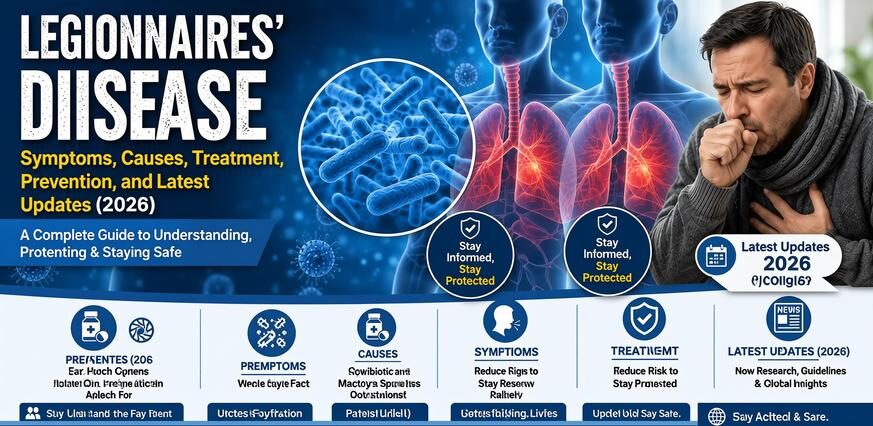
Legionnaires’ disease is a fatal pneumonia caused by Legionella bacteria, which have adapted to exist in freshwater environments and multiply in artificial systems containing stagnant water. It is an uncommon illness, but can be fatal in older people, smokers, persons with lung disease, and immunocompromised individuals.
In addition, the appropriate antibiotic treatment can reduce the severity of the disease, further indicating the importance of disease in the awareness. Global health authorities continue to receive reports of sporadic cases linked to cooling towers, hotels, hospitals, cruise ships, and other large plumbing systems.
This article provides complete information about Legionnaires’ disease – from the etiology to the prevention measures. The material can be helpful for those who want to get an accurate conception of the condition, support persons with Legionnaires’ disease, or prepare a relevant health guide. This article provides an overview of Legionella bacteria biology, clinical features of infection, methodologies for diagnosis, and therapeutic options.
What Is Legionnaires’ Disease?
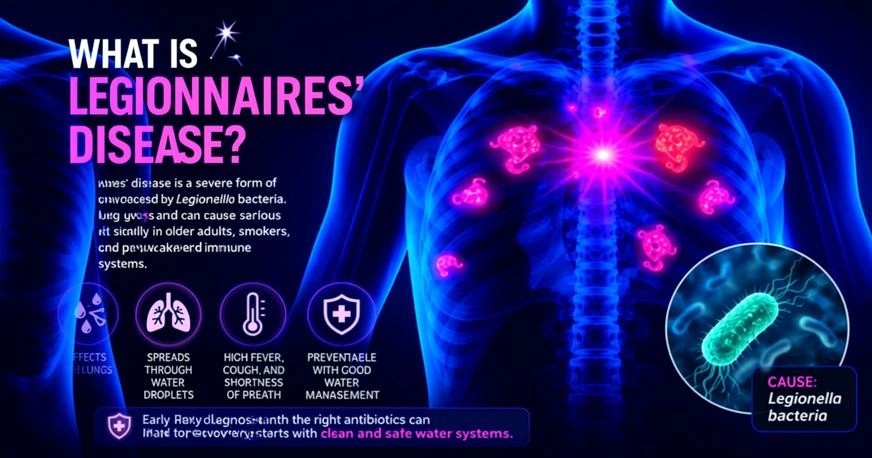
A man-made disease caused by bacteria from the same family, it has a fever, chills, headache, and muscle pain occurring approximately two to 14 days after exposure. Legionnaires’ disease is also not contagious, so you can’t catch it from another man. You can be exposed in an industrial setting such as a cooling tower, hot tub, or shower, or in homes through big plumbing systems, or even decorative fountains. When you breathe in the bacteria, they travel to your lungs and interfere with the cells of your immune system, causing inflammation and, in the end, pneumonia.
Is possible for everyone to die from it, but it is especially high risk ones are elderly, people who have a weak immune system, or those who already have health issues. Typically, it begins with feeling a lot like you’ve got the flu: fever, chills, headache, muscle aches, and feeling beat up. Wait a few days, and you’ll likely get a hacking cough, chest pain, and difficulty breathing.
Since these signs are found in many other respiratory diseases, diagnosis of this disease requires laboratory investigations. Modern antibiotics are very effective when started early – but can be deadly if they are not. Improved clinician awareness and enhanced water management programs have prevented many outbreaks, although sporadic cases continue to be reported from all over the world.
History of Legionnaires’ Disease
Legionellosis came to the world’s attention in 1976 when a large outbreak of illness occurred among participants at an American Legion meeting in Philadelphia, Pennsylvania. In a few weeks, more than 200 people got sick with a bad pneumonia, and scores died before investigators linked the epidemic to a so-far-unknown bacterium. The bacterium was named Legionella pneumophila, and the disease related to the American Legion was named Legionnaires’ disease. disease.
This seminal report transformed the manner in which public health problems were brought forward and warned us that building water systems should be tested for bacterial contamination. Part of the increased understanding of this niche microbial agent and its associated disease includes the identification of more than 60 species of “Legionella” since that historic outbreak, with “Legionella pneumophila” still causing the vast majority of infections in humans.
The detection of outbreaks has improved considerably with progress in diagnostic testing, environmental surveillance, and the control of water systems. Now, governments and health experts are advising a full-scale water management regime for hospitals, hotels, nursing homes, and other large buildings with complicated plumbing systems, where poor maintenance can encourage the growth of Legionella bacteria. Prevention of infection with these interventions remains important for public health and may also play a key role in preventing future outbreaks.
What causes Legionnaires’ disease?
Legionnaires’ disease is a pneumonia caused by infection with Legionella pneumophila bacteria (Legionella spp.). This organism can live in water, including water in lakes and streams, and within the community water supply. Fortunately, these bacteria are relatively scarce in natural habitats, which means that a person will rarely get infected in a natural environment.
The situation is dangerous when the bacteria get into the water supply system of buildings or other closed structures where they can proliferate. Warm water temperature, standing water, deposits, scale, rust, and insufficient amounts of disinfectants contribute to the creation of favorable conditions for the reproduction of Legionella bacteria.
Large buildings, hotels, hospitals, ships, spas, air conditioning systems, fountains, and other objects with a large water circulation system are considered to be the most vulnerable environments for the proliferation of these bacteria. Many infectious diseases are frightening because they are very dangerous, but they all have one crucial weakness – the ability to invade other living organisms is their main and only weakness.
However, in the case of Legionnaires’ disease, this weakness is not available to the infected person, because they are introduced into the human body with the water droplets inhaled from the air. The bacteria, getting into the lungs with the air, penetrate into the cells of the immune system called macrophages and replicate there. Instead of killing the bacteria, the cells of the immune system create a safe environment for their proliferation, leading to inflammation and pneumonia.
This ability of Legionella pneumonia is the reason for the severity of the disease course, especially in people with a suppressed or weakened immune system. Nevertheless, the identification of the source of legionellosis infection is crucial for controlling the spread of infection because, by monitoring and regulating the concentration of bacteria in the water, it is possible to eliminate the risk of legionellosis.
The Legionella Bacteria for Dummies
Leigionella neumofilla: The CDC was informed of this bacterium’s growth in warm water environments, with 25°C to 45°C (77°F to 145°F) being regarded as the appropriate temperature. Living within free-living amoebae, Legionella is an endosymbiont of the water-dwelling protozoan, which is found in aquatic habitats, and which shields it from environmental pressures including disinfection.
Its growth within amoebae is also thought to contribute to the bacterial ability to infect human immune cells and cause disease as an inhaled pathogen. More than 60 species of Legionella have been described, but the majority of disease is caused by L. pneumophila serogroup 1. Since Legionella is so tough, Legionella is, therefore, a public health hazard. Biofilms — a slime layer formed by bacteria and other microorganisms on the inner surfaces of pipes — are also safe havens where bacteria can multiply and hide from disinfectants.
Old plumbing, neglected cooling towers, pipe stubs with little water flow, and temperamental temperatures can all contribute to the proliferation of bacteria. Water management protocols for hospitals and nursing homes need to be higher than high, as their patients are more compromised and more likely to become ill.
Present-day water safety plans are based on temperature control, maintenance of an adequate disinfectant residual, prevention of stagnation (flushing), and monitoring for the presence of contamination, particularly in high-risk systems.
How Does Legionnaires ‘ Disease Spread?
A lot of people wrongly believe that you can only catch Legionnaires’ disease from direct contact with another person who has it, but this is a rare occurrence, and infections are much more likely to come from some kind of water source. That’s because the bacteria are found in small droplets of water that can be suspended in air and inhaled by those in proximity. One place where this bacterium has been known to thrive is in cooling towers that are connected to commercial air conditioning systems.
Breeding grounds outbreaks have happened as a result, since these droplets can hold bacteria over great distances, and everyone who is breathing in those droplets around you could also be at risk. Other sources of water, like fountains, hot tubs, spas, and humidifiers, can harbor and spread the bacteria.
There’s no reason to be concerned about Legionella-contaminated drinking water, as far as that goes, since the bacteria themselves are typically destroyed by the acidic environment of people’s stomachs before they can cause any harm. Legionnaires’ disease can also be acquired through aspiration, i.e., the presence of water in your lungs without swallowing it.
That can be a danger for the elderly as well as for those who have trouble swallowing. Investigation into outbreaks normally involves taking water samples from suspected water sources so that they can be tested, and then working with building owners to make sure their water systems are cleaned and disinfected so that no one else catches Legionnaires.
The response to an outbreak typically involves collecting water samples and then partnering with building owners to ensure that all of their water systems are treated. It’s helped stop some outbreaks and increased awareness of Legionnaires’ disease.
What are the signs and symptoms of Legionnaires’ disease?
The incubation period, or the time it takes for the signs to develop, is usually two (2) to ten (10) days in the case of Legionnaires’ disease. In extreme circumstances, it can last up to two weeks. It generally has a slow onset and can be mistaken for influenza or some other form of pneumonia.
The symptoms are a high temperature, chills, headache, muscle pain, fatigue, and malaise. However, since these are symptoms of all sorts of infectious diseases, the majority of people sick with Legionnaires’ disease will not indicate that they have anything more serious than the flu or a bad cold.
Then the lungs are invaded by bacteria; symptoms are respiratory. During high intermittent fever (which often remains high above 39 °C (102 °F)), a cough, with or without sputum production, and dyspnea develop. The dirty expectoration may be blood-stained sometimes, and the patients also face weakness and tiredness.
Elderly people can become mentally confused. But that’s not the case with Legionella — an organism responsible for a form of pneumonia called Legionnaires’ disease, which can cause symptoms to manifest beyond the lungs, including diarrhea, nausea, vomiting, abdominal pain and loss of appetite.
Vertigo and decreased attention probably also occur. If not treated, the infection can cause respiratory failure, septic shock, renal failure and multiple organ failure. The outlook is determined by the individual’s age, baseline health, and speed in receiving appropriate medical support. So, recognizing the signs and symptoms of Legionnaires’ disease and seeking medical attention at the earliest is essential
Early Symptoms of Legionnaires ‘ Disease
Complications were the first manifestation of infection in approximately 10% of patients on presentation, while symptoms lasted a median of 3 days. Most of the patients describe abrupt fever, chills, profound weakness (asthenia), myalgias, and cephalalgia.
It is very sickening, and you are unable to go on with your day,” said Kerry Stein, who contracted the virus in 2017. In addition, they don’t see the difference between this disease and a cold because the symptoms are the same. However, with Legionnaires’ disease, fever is usually higher, and the condition gradually improves. In addition, unlike a cold, people experience a dry cough, which later becomes productive.
Legionnaires’ disease is often hard to suspect based on symptoms alone. This infection commonly presents with symptoms that are similar to those of flu, COVID-19, and other respiratory illnesses. Healthcare providers attempt to assess the patient’s risk factors, including recent travel, hospitalizations, and jobs, to support the diagnosis.
People who stay in large buildings and use their spas should be particularly cautious. Moreover, a doctor should be consulted immediately if the symptoms resemble those of Legionnaires’ disease to ensure proper treatment. Otherwise, the disease can lead to severe health problems.
Severe Symptoms and Medical Emergencies Essay
In the advanced stages of Legionnaires’ disease, the infection causes inflammation of the lungs that impedes breathing. That is because the patient becomes dyspneic even at rest, breath rate increases and breathing is laboured, s/he has chest pain that aggravates with breathing, there is a productive cough that occasionally brings up blood.
Also, the oxygenation may drop, and that may necessitate oxygen administration in the hospital. Also, confusion and disorientation are common among the elderly, which is a sign that the infection has metastasized in the body. If you have a high fever for a long time, you should go to the emergency room because it might be a warning that you have had the infection for too long inside your body.
At that point, the infection can cause respiratory failure requiring intensive care support, potentially including ventilatory support. This can also lead to sepsis, kidney damage, heart disease, and shock, particularly in those who are chronically ill or immunocompromised. So they should go to the emergency room if they begin to feel very much worse or if they develop the symptoms I just told you about.
For example, you need emergency help right now if you can’t breathe on your own, are delirious or confused, have bluish lips and fingernails, or stop responding to stimuli. Although treatment in a hospital with antibiotics has increased the survival rate of Legionnaires’ disease, prompt treatment is still vital in reducing the risks posed by the infection. Delays in diagnosis are a common reason why the infection leads to serious complications or death.
Who Is Most at Risk?
As mentioned above, any person can get Legionnaires’ disease from consuming the polluted water. However, some of these people are most likely to be affected and suffer from serious complications. At the outset, we should note that the majority of legionellosis cases in our study were among individuals aged ≥50 years, which can be related to the lower level of their immunity.
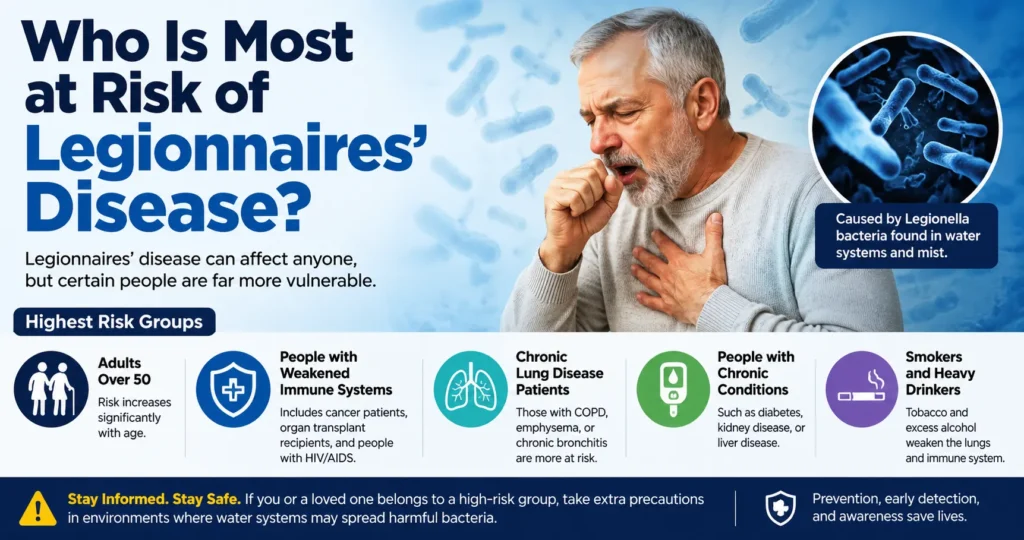
Somebody may also be at risk if he/she has pre-existing lung disease like COPD, Bronchiectasis, Pulmonary fibrosis, or Emphysema. Cigar and cigarette smokers and former smokers also face a greater risk than non-smokers. The third group of people who are susceptible to being infected is those who’ve been compromised for an array of reasons.
This can occur if someone has a transplant, is on immunosuppressive drugs, or has a co-morbid condition like HIV, kidney disease, or diabetes. Also, lung cancer, liver disease, and heart disease appeared to be risk factors for the development of legionellosis. Hospital administrations must identify these people and keep an eye on them since they are the most likely to be hospitalized due to this illness.
Diagnosis of Legionnaires disease
The clinical presentation of Legionnaires’ disease may be indistinguishable from that of other pneumonias, including viral and bacterial. He asks about recent travel and potential exposure to hotels, hospitals, or any place where you might be near big crowds of people, as he examines you.
Hot tubs, cooling towers, fountains, and other potential sources of water tainted with Legionella bacteria: have the physician ask, also, if you have been exposed. There will also be a listening to lungs with a stethoscope for abnormal breath sounds (including crackles, a type of rales), a check of your oxygen levels read by a pulse oximeter, and a measurement of your temperature, pulse, and respiratory rate.
Normally, these are not diagnostic procedures, and there is nothing to differentiate Legionnaires’ from any other pneumonia from what the eye can see. Therefore, diagnostic tests that can detect and confirm Legionella bacteria are needed to identify Legionnaires’ disease.
Several laboratory tests can diagnose Legionnaires’ disease. The test for Legionella pneumophila urinary antigen is the most common because it is quick and detectable for the most common Legionella species. At the same time, other tests can be done, such as sputum culture and polymerase chain reaction, and they can help determine whether the infection is present in the body and identify the type.
In addition, radiography and computerized tomography of the lungs are typical methods for diagnosing pneumonia, but they do not reveal the causative agent of the disease. Complete blood tests usually show elevated inflammatory markers, while biochemical blood tests indicate impaired kidney and liver function. Moreover, early detection of the infection is critical, and appropriate treatment is significant because Legionnaires’ disease can be fatal in severe cases.
Treatment of Legionnaires Disease
Antibiotics constitute the mainstay of treatment for this infection, and they have to get to the site of infection to combat the disease. The physicians advise using azithromycin or a respiratory fluoroquinolone, for instance, levofloxacin. Both of them are highly efficient in terms of fighting legionellosis.
The treatment course starts immediately when the disease is suspected, not waiting for the test results because time is critical in such cases. Typically, the doctor will prescribe the antibiotics for a period of 7-14 days based on the state of the patient’s health. In case of a severe condition of the patient, he should be admitted to the hospital.
Those diagnosed with pneumonia or who have trouble breathing or low blood oxygen levels also require supplemental treatments including fluids, oxygen therapy, and bringing down fevers. The intensive care unit is also available for Legionnaires’ disease patients, who need to be supported by breathing machines.
The good news is that most patients make a full recovery after effective treatment, though they may feel tired for a few weeks or months after the antibiotics are stopped. It is a critical error to treat Legionnaires’ disease without a doctor’s prescription or to stop taking antibiotics too early, as this can lead to antibiotic resistance and make the infection even harder to cure.
Prevention of Legionnaires’ disease Essay
Legionnaires’ disease prevention differs from that for other infectious diseases, which tend to focus on the infected person-to-person transmission procedures, as the disease is really a matter of suppressing the growth of Legionella within a water system. Building owners/healthcare/hotels and manufacturers/others that have water systems are responsible for the proper maintenance of those water systems.
These processes can involve temperature control, prevention of water stagnation, sufficient disinfection and sterilization of cooling towers , and flushing of inactive pipes. Businesses also should perform regular inspections and test high-risk equipment. The above lie is easily proven false and will result in a dramatic fall in Legionnaires’ disease.
Furthermore, one can avoid Legionellosis by taking care to maintain good water quality in one’s living spaces. As an illustration, a tourist should stick to accredited accommodations, and community members should spit out of showers and faucets not used regularly.
People with weakened immune systems should talk to their doctors about everything they do — including going to water parks and using hot tubs. And companies that run cooling towers or have art fountains should test the water conditions regularly and have routine tests to ensure they are meeting current regulations. Overall, the control of Legionella infection requires significant input from numerous organizations and individuals; all must play their part to help reduce Legionnaires’ disease.
Possible Complications
Even though many individuals recover from Legionnaires’ disease with proper treatment, the condition can lead to various complications. e.g., elderly and immunocompromised persons are at higher risk of having severe pneumonic forms. As a result, Legionella infection has the potential to cause respiratory failure, that is, the lungs no longer supply the body with oxygen-rich air.
Pneumonia induced by Legionella bacteria may result in respiratory failure, with patients requiring admission to an intensive care unit for care. Now, sepsis—which is a deadly full-body response to infection—can also be triggered by Legionnaires’ disease. It frequently causes injury to other organs, such as the kidneys, liver and heart, and septic shock, which can be survived only with intensive care.
Tiredness, compromised lung function and weakness may also be long-lasting after infection with Legionella. Immunocompromised persons as well as patients with underlying chronic disease may undergo pulmonary rehabilitation as inpatients. In addition, the disease may cause renal failure, myocarditis, neurologic complications, and impaired pulmonary function.
These are just some of the complications that underscore the need for prompt diagnosis, or Legionnaires’ disease will live up to its name. All the more so because, detection legionnaires’ disease is detected late, the outcome tends from bad to worse. So it is very important to see a doctor if you think you have pneumonia.
Prognosis and Recovery
The overall prognosis for Legionnaires’ disease is positive due to the availability of reliable diagnostic tests and appropriate antibiotics. Treating the condition in a timely manner allows patients to return to normal life without aftereffects. The length of time a person is ill depends on things such as the individual’s age and health and symptom severity.
People infected with low-virulence strains, for example, can have mild symptoms for several weeks. In contrast, the most seriously ill who need intensive care can be sick for longer than a year. Patients should also expect to feel weak and fatigued even after recovering from Legionnaires’ disease.
The mortality rate also varies depending on the setting and the population group. For example, people who acquire the infection in the community and seek treatment promptly have a better chance of survival than those who get it in the hospital. This outcome is mainly because the latter group consists of individuals with compromised immunity.
Adhering to the suggested guidelines for rehabilitation may also minimize the chances of permanent damage and facilitate your recovery. These are: breathing exercises; diet; stop smoking; and follow-up visits. More crucially, though, you should seek professional medical advice as early as possible to enhance the prognosis and prevent the development of complications.
Latest Updates on Legionnaires’ disease (2026)
Healthcare officials are constantly working on Legionnaires’ disease prevention and control since it remains a severe bacterial infection that leads to pneumonia. Thanks to ongoing scientific research, new ways to quickly diagnose Legionnaires’ disease outbreaks through polymerase chain reaction are being developed.

These advanced methods allow researchers to identify contaminated water sources at an early stage. Moreover, many hospitals and healthcare facilities are implementing water management programs to ensure the reduction of Legionella pneumophila bacteria in their water systems.
Scientists are also working on different approaches to Legionnaires’ disease control, such as creating new computer software to assess water quality and designating alternative ways to kill Legionella bacteria in the water sources of large buildings. Besides, due to proper education and awareness, medical workers are now more likely to recognize Legionnaires’ disease symptoms and start treatment in the early stages of the disease.
Many facilities across all regions are being educated on the importance of keeping the water clean and controlling the number of Legionella pneumophila bacteria. Even though today Legionnaires’ disease is well-managed, it will still be a significant problem if the proper prevention on a global level is not established.
External Link
- Centers for Disease Control and Prevention (CDC)
- World Health Organization (WHO)
- European Centre for Disease Prevention and Control (ECDC)
Internal Links
- Pneumonia: Symptoms, Causes, and Treatment
- Respiratory Infections: Prevention and Care
- Cyclospora Symptoms: Complete Guide
- General Health and Disease Prevention
- How Bacterial Infections Affect the Human Body
Conclusion
Legionnaires’ disease is a severe illness that can cause pneumonia and is preventable. It is caused by infection with Legionella bacteria. It is acquired by breathing in water that contains Legionella.
Even though it is a serious infection that can be fatal in the elderly population, smokers, and immunocompromised individuals, modern medicine has made remarkable progress in curing the illness.
The key to preventing Legionnaires’ disease lies in understanding the bacterium’s nature and being able to recognize the symptoms on time to ensure early intervention and treatment.
Preventing Legionnaires’ disease requires the implementation of proper maintenance and management strategies for water within a building. It remains the responsibility of authorities, healthcare workers, and the public to ensure that Legionnaires’ disease has no significant impact on the population.
With continued research and vigilance, the public health burden of the infection will only be mitigated, and a safe water environment will be achieved.
FAQs
1. Is Legionnaires’ disease contagious?
Is it? That’s not good. Legionnaires’ disease can’t be spread from person to person. “Legionella spreads when people breathe in aerosolized water containing bacteria from water. That is the only way it is spread
2. Early Symptoms and Signs of Legionnaires’ disease: What are the symptoms and signs of early Legionnaires’ disease?
Early symptoms could be high fever, breaking out in cold sweat, severe headache, full body ache, fatigue, and cough and having trouble while breathing. It Can Also Because You to Struggle To Breathe If you leave it untreated.
3. Who gets Legionnaires’ disease?
People most vulnerable to the disease are those with weakened immune systems and the elderly, with the majority of cases occurring in those aged 50 and over or in current or previous smokers.
4. Can Legionnaires’ disease be cured?
Yes, there is. They usually recover completely with treatment, including antibiotics.
5. How can Legionnaires’ disease be prevented?
Some of the disease prevention is to ensure the water is treated and not stagnant. Faucets and shower heads should be maintained and cleaned regularly, as should extensive water systems (cooling towers, etc.).
1 thought on “Legionnaires’ disease: Symptoms, Causes, Treatment, Prevention, and Latest Updates (2026)”