
Introduction: Pomegranate Compound Improves Heart Function
The pomegranate is a food that researchers have studied because of the variety of polyphenols it contains. Researchers have studied the impact of ellagitannin (punicalagin) from pomegranate on oxidative stress, inflammation, the vasculature, and cardiac function.
The attention-grabbing title of this article, “Pomegranate Compound Improves Heart Function,” is, indeed, quite a grabbing one. However, the reader should be aware that research thus far has investigated the relationship between pomegranate and cardiovascular health at the lab bench and in animal models. Human clinical trials have been limited to pomegranate juice and extract and blood pressure, vascular function, and vascular function-related biomarkers. Scientists have yet to demonstrate that an isolated pomegranate molecule could serve as either a treatment for heart disease or a substitute for traditional cardiovascular drugs.
Contemporary studies continue to investigate the ability of polyphenols in pomegranate to modulate cardiovascular events. The latest article to draw attention to punicalagin from an evidence-based perspective for 2026 has reviewed the possible mechanisms through which it may influence oxidative stress, inflammation, endothelial function, and lipid metabolism. Be aware that a lot of the above-mentioned research has been done in preclinical models, and further human studies are warranted.
What Is Punicalagin?
Punicalagin is classified as an ellagitannin (a category of tannins that are plant polyphenols that are soluble in water). Pomegranates also contain ellagic acid, anthocyanins, and additional polyphenols.
These substances are the subject of study for their possible activities and interactions with biological events associated with oxidative stress and inflammation.
Crucially, eating a pomegranate is not the same thing as taking a highly concentrated extract of a particular compound. The content of polyphenols varies between different products – fruit, juice, extracts, supplements – and it is impossible to say from any one study what combination you are likely to get.
This is an important point to consider when looking at the research evidence.
How Could Compounds in Pomegranate Affect the Heart?
There are multiple proposed mechanisms by which this fruit may affect the heart.
1. Fighting Oxidative Stress
Oxidative stress occurs if your body’s antioxidant systems are overwhelmed by free radicals. Excess oxidative stress may lead to damage in cells all around your body.
The polyphenols in pomegranate have antioxidant properties, and scientists have theorized that they may help fight oxidative damage.
When tested on rats with induced heart issues, the administration of polyphenols from pomegranate resulted in better function of the heart and reduced oxidative damage. However, this was an animal study, and results may not apply to humans.
2. Support for Blood Vessel Function
The endothelium is the membrane that lines the blood vessels. Normal endothelial function is required for blood vessels to appropriately dilate and constrict in response to changes in blood flow.
A 2025 systematic review and meta-analysis of 19 RCTs with pomegranate juice, extracts or compounds and vascular endothelial markers reported mixed effects of pomegranate on various markers of vascular function. The authors noted that pomegranate significantly reduced inflammatory markers ICAM-1 and IL-6, but had inconsistent effects on other outcomes.
This suggests that while pomegranate may impact biological pathways related to blood vessels, it cannot be concluded that pomegranate prevents cardiovascular events.
3. Nitric Oxide Pathways
Nitric oxide is an important regulator of vascular relaxation.
The authors of one of the studies on pomegranate’s effect on the cardiovascular system tested the hypothesis that pomegranate extract might have some effect on nitric oxide pathways. The study used isolated hearts from rats, but the researchers were able to demonstrate that pomegranate juice was able to reduce damage to the heart from ischemia followed by reperfusion, with nitric oxide apparently playing a key role. However, once again, this is an example of an experimental study, not an indication that pomegranate juice actually has beneficial clinical effects in the treatment of cardiovascular disease.
4. Inflammation
Chronic inflammation is involved in processes of cardiovascular disease.
The polyphenols in pomegranate are under investigation for potential anti-inflammatory properties. The 2025 meta-analysis showed a statistically significant reduction in IL-6 in 14 studies, but the researchers also found substantial heterogeneity for some outcomes.
This is an interesting area of research, but inflammatory markers do not tell us whether a food or a supplement prevents heart attacks or improves survival rates.
What Human Studies Have Found
Human trials are more practical. In a randomized, placebo-controlled study therapy this is concerning 45 individuals with coronary heart disease who consumed drinking pomegranate juice daily, a reduction in stress-induced myocardial ischemia was observed in the pomegranate group compared to the control group over 3 months. Another study compared 100 people with ischaemic heart disease given pomegranate juice in addition to standard medical care while they were in hospital for 5 days, and found they had less angina and some biomarkers in the pomegranate group.
The results are certainly interesting, but individual trials can have small sample sizes or short timeframes or be done on specific populations, and one trial’s results shouldn’t be taken as an overall indicator of effectiveness for all patients.
What Does The Broader Evidence Say?
The broader evidence suggests more caution than the headlines. The National Center for Complementary and Integrative Health (NCCIH) notes that there is not enough evidence from human studies to back up the claims made for pomegranate. However, most studies have used pomegranate juice, rather than dietary supplements. The report says that pomegranate juice or extract may help lower blood pressure, but that further research is needed for other conditions. The review also states that there is no conclusive evidence for reducing cholesterol, and that research is insufficient to draw any conclusions on several of the other health conditions it was tested for.
A systematic review of randomized trials that evaluated the effects of pomegranate on blood pressure, then, also found ‘inconclusive’ evidence that it helps to lower blood pressure. The review included eight trials with 619 participants and concluded that the evidence at the time did not convincingly show that pomegranate lowered blood pressure.
That’s one part that’s really important to remember – that promising-sounding mechanisms don’t always pan out in terms of actual proven benefit.
A Pomegranate in a Heart-Healthy Diet and Lifestyle
Is a pomegranate a fruit that you can incorporate into your diet and still enjoy? The American Heart Association’s (AHA) 2026 diet recommendations for the general population emphasize a heart-healthy diet pattern. Nothing within it “calls out” specific foods or nutrients, but rather the message is around eating a variety of nutritious foods — including fruits and vegetables, whole grains, lean proteins, and low-fat dairy — and limiting added sugars and sodium, as well as avoiding highly processed products.
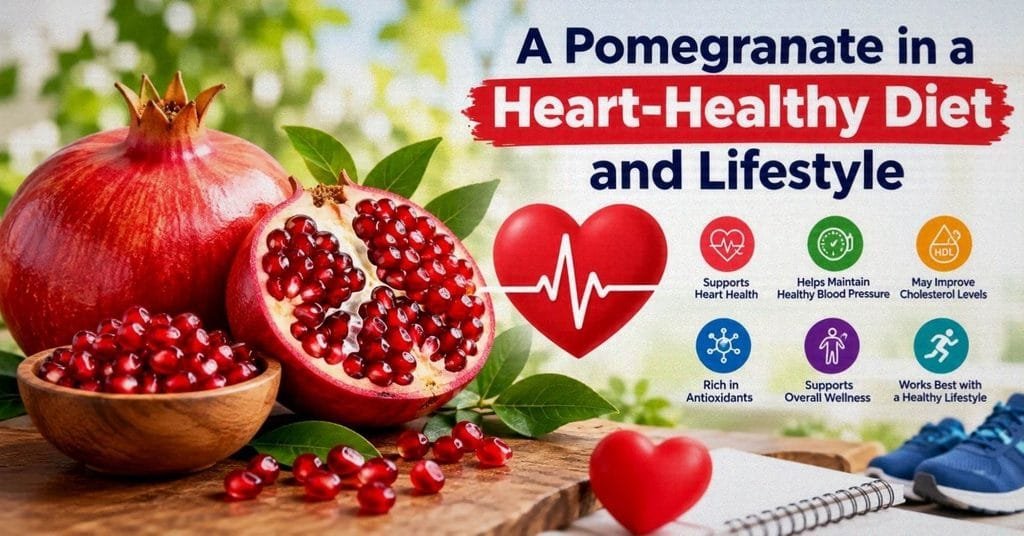
For that reason, it’s better to consider pomegranate’s place in the diet in the context of individual foods that can be included as part of an overall heart-healthy dietary pattern. In addition, whole pomegranate seeds or arils are also good sources of fiber, along with other nutrients. The American Heart Association says they’re rich in heart-healthy polyphenols and fiber, and they do contain a few other important nutrients, including folate, potassium, and vitamin K.
Pomegranate whole fruit vs. juice
Fruit whole and Juice not Equal.
Whole Pomegranate
Provides:
- Fiber
- Polyphenols
- Naturally occurring carbohydrates
- Micronutrients
- Water
Cooking the arils can help you add some fiber, which is stripped away or missing in many juice products
Pomegranate Juice
Although it has a plentiful amount of polyphenols, this beverage tends to be low in fiber. Some brands have added sugar, which means you should look at the nutrition label. If you are going to drink it, you should get unsweetened juice instead of a sugar-sweetened beverage, especially if you are going to eat it as part of a generally healthy diet.
Could Pomegranate Substitute for Heart Medication?
No.
There is no evidence at present to indicate that pomegranate, pomegranate juice, or a pomegranate supplement can substitute for prescribed heart medications.
Patients with hypertension, CAD, hyperlipidemia, heart failure, previous MI, or other cardiovascular disease should continue to adhere to their clinician’s advice regarding treatment.
Diet can promote overall health, but “it is not a substitute for clinically indicated medication or medical care,” he wrote.
Pomegranate Supplement Safety
Pomegranate juice is generally safe for most people, and the same can be said about the extract — with some caveats. According to NCCIH, pomegranate juice could cause digestive issues for some individuals and allergic reactions in others. The NIH also warns that a large quantity of pomegranate roots, stems, or skins is unsafe.
Herbal supplements and extracts can have interactions with other drugs, so if you are taking any medications or have a health condition, it’s safest not to take them. Consult a healthcare provider before you add any dietary or herbal supplements to your regimen, regardless of how ‘natural’ they are.
How Much Pomegranate Should I Eat?
There is no defined therapeutic dose of pomegranate or punicalagin for the improvement of cardiovascular function. Different doses have been employed in the studies, and the results are not consistent; also, the duration of the treatment varied, since the longest period of follow-up was 1 year. Because of this variability, one dose cannot be applied to all subjects. Pomegranate can be part of a heart-healthy diet, especially when enjoyed alongside a variety of other fruits and vegetables. Having more of a pomegranate product isn’t necessarily better. When considering the use of a pomegranate extract or supplement, consult your physician or a pharmacist—especially if you are on any medications.
What is the significance of this study?
The pomegranate compounds were of interest because of the possibility that they could affect multiple biological pathways.
Compounds like punicalagin are being investigated to see if they can:
- Reduce oxidative stress
- Influence inflammatory pathways
- Support endothelial function
- Affect nitric oxide signaling
- Influence lipid metabolism
- Preserve heart muscle during in vitro ischemia-reperfusion injury
A review in 2026 identified some of these mechanisms, and in comorbid preclinical as well as clinical research with punicalagin. However, the authors’ discussion of potential cardiovascular applications should not be interpreted as proof that punicalagin is an established cardiovascular treatment.
What Researchers Still Need to Find Out
There are a few crucial questions that have no answers yet. Researchers need to conduct larger, longer studies in humans to see if
- 1. Pomegranate compounds actually have beneficial effects on clinically relevant cardiovascular outcomes,
- 2. Whether the whole fruit, juice, or a standardized extract is most likely to be beneficial,
- 3. What doses might be needed to see benefits without causing unwanted side effects,
- 4. Whether healthy and cardiovascular patients could benefit,
- 5. The potential interactions of pomegranate components with other drugs commonly employed in the treatment of cardiovascular disease, and
- 6. Whether consuming pomegranate extract can decrease the likelihood of a heart attack or stroke.
This is important because although laboratory measurements have shown beneficial effects, it does not mean those effects are present in humans.
Practical ways to include pomegranate in your diet
If you like pomegranate, you can use it in meals in a variety of tasty ways, without trying to think of it as medicine.
You might try:
- Tossing the seeds into plain yogurt
- Sprinkling them over oatmeal
- Mixing them into a salad
- Adding them to whole grain dishes
- Using them as a topping for unsweetened foods
- Choosing to eat the whole pomegranate instead of drinking the fruit in concentrated, sweetened, processed form.
A variety of fruits and vegetables should be consumed as part of a heart-healthy diet, according to the American Heart Association.
External Links
Internal Link
For your health website, you can naturally connect this article to your existing “Popular Supplements That May Have Unexpected Side Effects” article. This creates topical relevance between supplements, safety, and cardiovascular research.
Conclusion: Promising Research, Not a Cure
The phrase “Pomegranate Compound Improves Heart Function” hints at exciting directions for future research into punicalagin and other polyphenols in pomegranate. In controlled trials, these compounds have shown potential to protect heart muscles. In humans, they have been linked to reduced blood pressure, improved heart muscle blood flow, and favorable changes in markers related to cardiovascular function as well as blood vessel structure.
Furthermore, it must be taken into account that the application of products from pomegranates cannot be an alternative to classic healthcare. Without robust nutritional information and good attributes, it just can’t compare to a balanced and healthy diet.
So it is advisable to adhere to widely accepted principles of healthy living: consume a diet rich in fruits and vegetables with pomegranates among them, engage in regular physical activity, maintain a normal body weight, control blood pressure and cholesterol levels, stop smoking, and protect and monitor one’s health, which includes undergoing periodic medical evaluations.
It reflects the 2026 AHA guideline’s greater emphasis on patterns of eating rather than individual foods when discussing the importance of a heart-healthy diet.
FAQs: Pomegranate Compound and Heart Function
1. Can pomegranate enhance the function of the heart?
The cardioprotective properties of pomegranate polyphenols have been reported in preclinical and clinical studies. However, the results of studies on cardiovascular parameters in human beings may only suggest, and not confirm, positive effects on the cardiovascular system after ingestion of pomegranate.
2. Is the pomegranate peel under investigation for cardioprotective effects?
Among the polyphenols present in pomegranate that have illustrated potential in preliminary studies is punicalagin.
3. Is pomegranate Good for Cholesterol?
Pomegranate is a fruit that you can add to your heart-healthy eating plan. However, now there is not enough evidence and it cannot be confirmed that eating pomegranate may contribute to helping prevent or treat the disease of the cardiovascular system.
4. Can pomegranate reduce blood pressure?
There is some evidence that pomegranate juice or extract may have blood pressure-lowering effects. The findings, however, are inconsistent, and it is not established whether it has a role in the management of hypertension. According to NCCIH, more research is needed before a conclusion can be reached.
5. Is pomegranate juice better than whole pomegranate?
Since you are likely to eat the whole fruit, pomegranate offers fiber as well as polyphenols. Pomegranate juice does not have as much fiber. How you eat pomegranate depends on your diet and what you are trying to accomplish with your food.
6. Can people who have heart disease drink pomegranate juice?
Studies have used pomegranate juice in people who have coronary or ischemic heart disease. Still, those with heart disease should discuss use of pomegranate juice on a regular basis or in large quantities with their doctor in particular if they are on other medications.
7. Can pomegranate be used instead of heart medications?
Pomegranate should not be used as a substitute for drugs that have been prescribed for cardiovascular disease or other conditions.
8. Are pomegranate supplements safe?
The studies done so far suggest that pomegranate juice is safe for most people. However, some people can be sensitive to pomegranate. Side effects such as upset stomach or allergic reactions are possible. Moreover, commercially available supplements may contain high concentrations of pomegranate extract. These could have harmful interactions with other drugs.
9. What is the best way to eat pomegranate?
You can eat pomegranate arils whole, or you can juice them. You can also find unsweetened pomegranate juice at a grocery store. A whole fruit is best because that’s where the fiber and the polyphenols that have been studied are found. As a high-sugar fruit, you might want to restrict your intake as well.
10. Is more research needed?
More research is necessary to determine whether particular pomegranate constituents have a potent effect on cardiovascular health. Further, population-based studies are required to investigate the potential of these compounds for the prevention of cardiovascular disease or modulation of their risk factors.
Note: This article avoids claiming that pomegranate cures heart disease or that one compound is proven to improve heart function in all people. That distinction is important for health-related content, where accurate sourcing, cautious wording, and clear separation of preclinical evidence from human clinical evidence are especially important.